
Paper Records Are Eating Your Company’s Profits
You’re organization is paying for that file cabinet and box archive every time someone searches a cabinet, requests a box, copies a document, or refiles a folder. Add storage charges, supplies, and occupied office space, and paper becomes a recurring business expense. Its literally “Death by a Thousand File Pulls” in perpetual time labor storage costs.
Win 20 New Customers or Cut $10,000 in Annual Paper Archive Costs
Winning customers takes marketing, sales calls, follow-up, and work to deliver what you sell. Here’s the comparison: 20 customers spending $2,500 each bring in $50,000 in sales. If your business keeps 20 cents from each extra sales dollar after covering the costs of those sales, that adds $10,000 to profit. Reducing annual paper-related expenses by $10,000 delivers the same profit boost. The opportunity starts with money you’re already spending.
“But the Paper in Our File Room Doesn’t Cost Anything.”
The paper may be sitting still. Your costs aren’t.
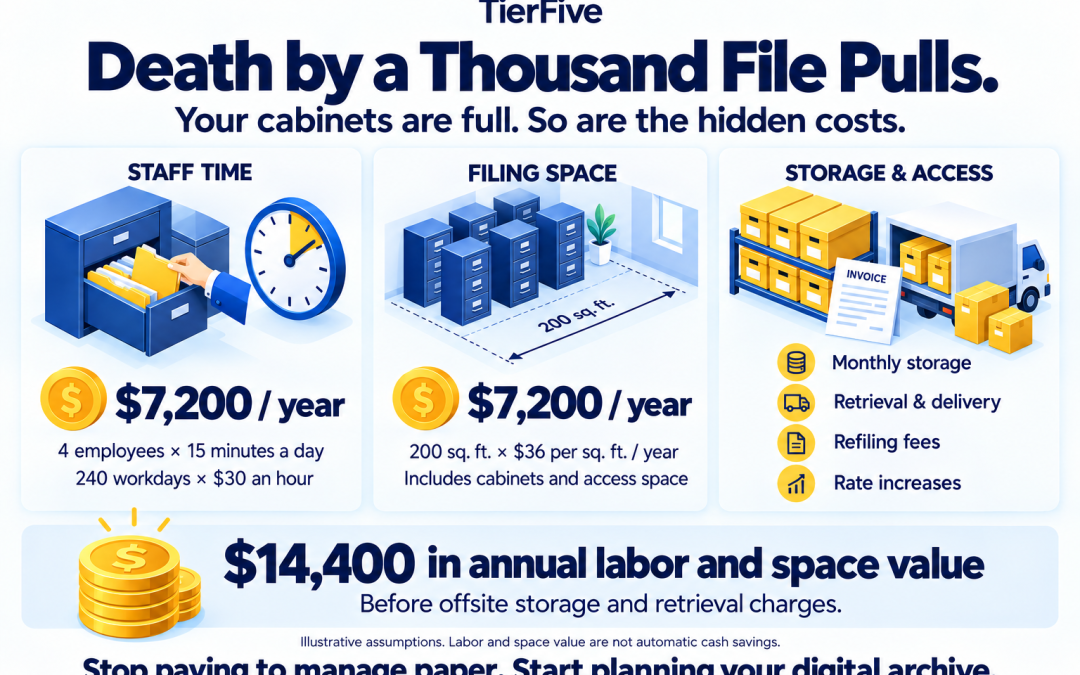
Suppose four employees each spend just 15 minutes a day finding, copying, and refiling records. At a total employment cost of $30 an hour, across 240 working days, that’s: 4 employees × ¼ hour × $30 × 240 days = $7,200 a year in staff time.
That’s before offsite storage, retrieval fees, delivery charges, copying supplies, or the space occupied by cabinets.
Recovering those hours gives employees more time for valuable work. It becomes a cash saving when it reduces spending, such as overtime or temporary staffing. Reclaimed space can also help avoid expansion, even when your current rent stays the same.
Find Out What Keeping Paper Really Costs
Estimate Your Paper Records Costs For project-specific pricing, contact TierFive or call (888) 547-2267.
The Full Cost of Storing and Managing Paper Records
Start with a defined collection: a department, a records room, or a group of offsite boxes. Count only the costs associated with that collection so the comparison stays meaningful.
Offsite storage: recurring charges that continue long after the work is finished
Paper can remain in storage for years after the transaction or project that created it has ended. During that time, your organization may pay monthly storage charges regardless of whether anyone uses the records.
Review invoices for storage, account administration, minimum charges, and other recurring fees. Include retrieval and delivery separately unless they are already part of the total.
Calculate: Add the actual storage-related invoices for the past 12 months. If you only have a monthly figure, multiply it by 12 and label it as an estimate.
Check before claiming savings: Which charges would actually stop if selected boxes were removed? Minimum account fees or retained originals may limit the reduction.
Retrieval, delivery, and refiling: paying to access your own information
A stored box can generate additional charges each time you request it. Rush service, delivery, temporary removal, return transportation, and refiling may make access much more expensive than the monthly storage rate suggests.
When these charges compound, a low-cost storage arrangement can become a significant operational burden. Review what you pay to retrieve the same collections repeatedly.
Calculate: Total the relevant access charges over a representative year. Separate routine requests from unusual one-time events.
Check before claiming savings: Scanning must provide the records and search capabilities users need. If employees still require the originals, some physical retrieval costs may remain.
Employee time: the cost that rarely appears on a storage invoice
Finding, requesting, collecting, copying, routing, and refiling paper takes time. A few minutes repeated across employees and working days can become a substantial workload.
Measure representative tasks rather than assuming a universal percentage of the workday. Include unsuccessful searches where they occur, but do not count the same minutes under multiple categories.
Calculate: Employees involved × average hours per employee per day × working days per year × loaded hourly labor cost.
Example: Four employees spending 15 minutes each day on relevant paper handling, across 240 working days at $30 per hour, represents $7,200 of annual labor capacity.
Interpret carefully: Recovered time is not automatically a payroll reduction. It may create capacity for other work, reduce overtime, or postpone hiring. Report those outcomes separately from direct cash savings.
Office space: what could your records room be used for?
Cabinets occupy more than their physical footprint. Include the access space, aisles, and staging areas needed to use the collection.
Measure your actual layout rather than assigning every cabinet a standard area. Use your lease figures and clearly distinguish annual from monthly rates.
Calculate: Measured storage area × annual occupancy cost per square foot.
Example: A 200-square-foot records area at an illustrative $36 per square foot annually represents $7,200 of allocated space value.
Interpret carefully: Clearing that area does not reduce a fixed lease payment by itself. It may support additional workstations, avoid expansion, or enable a smaller future lease. Count cash savings only when spending actually changes.
Copying, equipment, and supplies
Paper retrieval can lead to duplicate copies, replacement folders, labels, storage boxes, postage, and equipment use. These categories also belong in a complete comparison.
Calculate: Identify supplies and usage costs attributable to the collection. Separate variable costs you can avoid from equipment payments that will continue.
Avoid double counting: If copier charges already include toner and maintenance, do not add those components again.
Delays, misplaced records, and rework
A missing file may require additional searching, reconstruction, or another request to a customer or vendor. Slow access can also delay service, approvals, billing, or project decisions.
Record actual incidents and the effort involved. Do not assume every delay represents lost revenue or assign a monetary value without supporting evidence.
Useful measures: Retrieval time, unsuccessful searches, repeat requests, reconstruction hours, and work waiting for records.
Interpret carefully: Treat measurable rework costs separately from broader operational benefits.
What Research Says About the Cost of Finding Information
Research from McKinsey, Microsoft, and Gartner shows why information retrieval deserves management attention. These studies address broader workplace information access, rather than measuring paper-scanning savings specifically.
McKinsey: nearly 20% of the workweek involved finding information or assistance
A McKinsey Global Institute report, The Social Economy, estimated that interaction workers spent nearly 20% of their workweek looking for internal information or locating colleagues who could help with specific tasks.
What this means for your archive: Retrieval is a business activity with a real time cost. Measure how much of that effort involves your paper records, including requesting boxes, locating folders, and returning documents.
Scope of the finding: This historical research concerned knowledge work and social technologies. It does not establish that employees spend 20% of their time searching paper files or that scanning would recover all of that time.
Microsoft: 62% reported spending too much time searching for information
Microsoft’s 2023 Work Trend Index, which surveyed 31,000 people across 31 countries, found that 62% of respondents struggled with spending too much time searching for information during their workday.
What this means for your archive: The search burden extends beyond filing cabinets. Converting paper should be paired with useful organization, indexing, and a practical destination system so employees can locate the resulting files.
Scope of the finding: The percentage describes respondents reporting a difficulty. It is not a measure of the percentage of time lost or a predicted productivity improvement from digitization.
Gartner: 47% of digital workers struggled to find information needed for their jobs
In research published in May 2023, Gartner found that 47% of digital workers struggled to find information or data needed to perform their jobs. The survey covered 4,861 full-time employees at organizations with at least 100 employees across the United States, United Kingdom, India, and China, with fieldwork conducted in late 2022.
What this means for your archive: Digital files alone are not enough. Define naming conventions, document categories, index fields, and repository requirements before scanning begins.
Scope of the finding: The study concerns digital workplace information access. It supports thoughtful retrieval planning, rather than a claim that scanning automatically resolves information-search problems.
Use research for context and your own measurements for ROI. Base projected savings on actual invoices, observed retrieval tasks, written conversion pricing, and the costs you can genuinely discontinue.
What Happens When Box-Storage Costs Keep Increasing?
The annual cost of an archive can rise even when you never add another box. Rate increases, service fees, and minimum charges deserve attention before they become a larger budget problem.
Understand the cumulative effect of rate increases
Compare the same services across invoices from different years. Separate price increases from changes in box count and retrieval activity.
Illustrative example: A $12,000 annual charge that rises 6% each year becomes approximately $15,150 in year five. Across those five years, charges total approximately $67,645, assuming the first year is $12,000 and four annual increases follow.
This example is not a forecast of any provider’s rates. Use your contract terms, actual history, and clearly labeled assumptions.
Include the cost of leaving the storage arrangement
Permanent withdrawal, transportation, inventory reconciliation, and account-closeout charges can affect a conversion budget. A scanning quote may not include fees charged by your existing storage provider.
Request a written explanation of the costs and procedures for releasing the selected records. Confirm any notice requirements and the charges that will remain for boxes you retain.
Decision point: Compare the complete transition cost with the recurring expenses you can actually discontinue.
Separate storage decisions from retention decisions
A box being expensive to store does not establish whether its contents can be destroyed. Review the collection’s status and your organization’s requirements before choosing scanning, continued physical retention, or authorized disposition.
A sensible project may digitize frequently used records, retain selected originals, and exclude records that do not belong in the conversion scope.
Disaster Recovery and Confidentiality Belong in the Decision
Costs matter, but access to critical information matters too. Evaluate operational exposure alongside the financial comparison.
Could your organization operate without the paper archive?
Identify the records needed to continue essential work if the physical collection becomes inaccessible. Consider fire, water damage, theft, transportation incidents, or a facility disruption.
Digitized files can be included in a recovery plan, but they still require protected storage, backups, access controls, and tested restoration. Scanning alone does not provide those ongoing functions.
Keep the analysis credible: Describe critical records and recovery requirements. Do not treat an assumed disaster loss as guaranteed scanning savings.
Who can access sensitive records, and how is handling documented?
Paper records may pass through desks, vehicles, storage facilities, and departments. Evaluate access, container identification, custody records, and exception handling.
Digital conversion creates an opportunity to apply consistent access permissions and audit trails where the destination system supports them. Those controls must be configured and maintained.
Keep the analysis credible: Evaluate concrete control improvements separately from direct cost reductions.
What Does Paper-to-Digital Conversion Cost?
A useful comparison includes the full transition and the ongoing digital environment—not simply a scanning price per image.
One-time conversion and transition costs
- Inventory review and project planning.
- Storage-provider withdrawal fees and transportation.
- Document preparation and separation.
- Scanning, OCR, indexing, and quality review.
- File delivery, import, and validation.
- Staff training and internal project time.
- Return or authorized disposition of originals.
Confirm which items are included in each quote. A lower capture price may describe less work than your archive requires.
Ongoing digital and retained-paper costs
- Repository hosting, storage, or software subscriptions.
- Backup, recovery, security, and administration.
- Remaining physical storage and original-record retrieval.
- Future scanning batches and related processing.
Compare incremental costs associated with the project. If you already operate a repository, identify additional licenses, capacity, and administration rather than assuming either zero cost or the entire system budget.
Indexing and organization that support actual retrieval
Define how employees will find the finished records. A customer identifier, invoice number, project reference, or document category may be more useful than an inconsistent folder name.
Agree on document boundaries, file names, required fields, validation rules, and sample output. Confirm that your destination system can use the metadata you receive.
Explore document scanning and indexing examples by industry.
How to Calculate Document Scanning Savings and Payback
Every Search. Every Copy. Every Refile. It Adds Up. Use the same collection, services, and time period on both sides of the comparison.
Annual net cash savings:
Avoidable annual paper cash expenses − incremental annual digital and retained-paper cash expenses.
Simple cash payback in months:
One-time transition investment ÷ annual net cash savings × 12.
Recovered labor capacity:
Annual hours eliminated × loaded hourly labor cost. Report separately unless it produces a documented spending reduction.
For simple payback, annual net cash savings must be positive. The formula assumes a stable annual benefit after implementation and does not account for financing, discounting, or a gradual rollout.
For a phased project, estimate costs and benefits by month or year instead. Storage savings may not begin until originals are released and billing changes take effect.
Worked Example: Comparing Paper Storage With Digital Conversion
Illustrative scenario only: These figures are fictional planning assumptions, not TierFive prices, a client result, or a promise of savings. An organization evaluates a defined archive and confirms which paper expenses can stop after conversion. It keeps retained-original costs and digital management in the comparison. Every Search. Every Copy. Every Refile. It Adds Up here is the math.
| Expense | Current paper arrangement | After conversion |
|---|---|---|
| Storage | $12,000 | $2,400 for retained originals |
| Retrieval and delivery | $3,600 | $600 for remaining original requests |
| Avoidable supplies and copying | $1,200 | $300 |
| Incremental digital management and backups | $0 | $2,400 |
| Total annual cash expenses in scope | $16,800 | $5,700 |
Annual net cash savings: $16,800 − $5,700 = $11,100.
| Item | Assumed cost |
|---|---|
| Preparation, scanning, OCR, indexing, and quality review | $12,000 |
| Withdrawal and transportation | $2,000 |
| Import, training, and internal implementation | $1,000 |
| Total | $15,000 |
Simple cash payback: $15,000 ÷ $11,100 × 12 = approximately 16.2 months.
Three-year net cash benefit: ($11,100 × 3) − $15,000 = $18,300, assuming three full years of the stated savings after implementation, unchanged costs, and no discounting. Recovered staff time and reclaimed space are excluded from this cash calculation. They may strengthen the business case, but should be reported separately unless they change actual spending.
What if the savings are lower than expected?
If annual net cash savings were only $7,500, the same $15,000 investment would have a simple payback of 24 months. At $5,000 annually, payback would be 36 months.
Test conservative assumptions for retained storage, access charges, digital costs, and the date billing reductions begin. A business case should remain understandable when optimistic assumptions are removed.
Gather These Numbers Before Requesting a Quote
- Invoices: Twelve months of storage, retrieval, delivery, and related charges.
- Contract information: Rate changes, withdrawal fees, minimum charges, and release procedures.
- Archive inventory: Boxes, cabinets, record types, approximate volume, and physical condition.
- Retrieval activity: Request frequency, staff handling time, and frequently accessed collections.
- Storage layout: Measured area, occupancy costs, and intended use of reclaimed space.
- Retention decisions: Originals that must remain and records excluded from conversion.
- Digital requirements: OCR, index fields, file formats, repository, access, and backup responsibilities.
- Timing: Project deadline, phased priorities, and expected start of savings.
Use TierFive’s ROI Calculator as a Starting Point
Calculator outputs are estimates. Supplement them with your actual costs, a written project quote, ongoing digital expenses, and realistic assumptions about which paper costs will stop.
Where Should You Start?
Frequently retrieved collections
Start where requests repeatedly generate charges or consume staff time. These collections can provide measurable retrieval benefits.
Define the index fields employees need before scanning. A digital archive that is hard to navigate will not deliver the intended improvement.
Archives with a clear opportunity to reduce storage bills
Identify boxes whose conversion and approved disposition would produce an actual billing reduction. Confirm the fee structure and minimum charges first.
Compare the complete transition cost with those avoidable expenses rather than the entire account balance.
Newly completed records that would otherwise expand the backlog
A historical archive project works better when new paperwork has a defined next step. Establish a recurring release process for completed files.
Explore scanning paper records after business processes are completed to prevent the backlog from continually rebuilding.
How TierFive Helps Define the Investment
TierFive can scope document preparation, scanning, OCR, indexing, quality review, and digital delivery around the records you need to use. Clear requirements help connect the project price with the outcome you expect.
TierFive quotes accurately for the agreed scope and sticks to that price. Additional work you request is discussed and approved before it proceeds.
When requesting a quote, identify withdrawal charges from your existing provider, destination-system requirements, and handling of originals. Confirm which expenses belong to TierFive’s scope and which are separate.
Explore document scanning services and questions to ask a scanning vendor.
Frequently Asked Questions About Paper Records Costs
Is scanning always cheaper than keeping paper?
No. The result depends on conversion requirements, access frequency, avoidable storage charges, retained originals, and ongoing digital costs. Evaluate the actual collection rather than assuming every archive has the same payback.
Do empty filing cabinets create immediate rent savings?
Not under a lease whose payments remain unchanged. Reclaimed space may support another use or avoid future expansion. Count rent savings only when occupancy spending actually decreases.
Can employee time savings be included in ROI?
Yes, as a clearly labeled productivity benefit. Keep it separate from cash savings unless it reduces overtime, staffing costs, or another documented expense. Do not count both the value of recovered hours and the same expense reduction twice.
How much does document scanning cost per page?
Pricing depends on volume, preparation, document condition, indexing, review, output, and delivery. Confirm whether pricing is per page, image, document, or another unit. Request a written quote covering the complete scope.
Will scanning eliminate all offsite storage charges?
Only if the relevant originals can be removed, the arrangement permits those charges to end, and no minimum or retained-storage costs remain. Include withdrawal and disposition costs in the transition budget.
Does scanning eliminate disaster or confidentiality risks?
No. Digital records require protected storage, access controls, backups, and recovery procedures. Evaluate the controls in both environments and define who maintains the digital system.
What is the difference between payback and ROI?
Payback estimates how long it takes cumulative benefits to recover the investment. ROI expresses a net benefit relative to the investment over a defined period. State the time period, included costs, and whether benefits represent cash savings or broader economic value.
Find Out What Keeping Your Paper Is Really Costing
Start with your invoices, a representative sample of retrieval activity, and a defined collection. You do not need a perfect page count to begin.
TierFive can help scope the conversion side of the comparison so you can evaluate a real project against the recurring costs of keeping paper.
Request a Document Scanning Quote for Your Archive
Call (888) 547-2267