
Alameda County Document Scanning Services
Secure Document Scanning, Microfilm Conversion & Records Digitization
TierFive provides secure professional document scanning and microfilm conversion services throughout Alameda County, California, with regularly scheduled records pickup in local service areas. We serve businesses, government agencies, healthcare organizations, educational institutions, and professional firms throughout Oakland, Fremont, Berkeley, Hayward, Pleasanton, Livermore, Dublin, San Leandro, Alameda, Union City, Newark, Emeryville, and surrounding communities. Whether you need to digitize a few dozen boxes of business records, thousands of archived files, microfilm or digitize oversized engineering drawings, TierFive provides secure, scalable document conversion solutions for Alameda County businesses.

🛡 Secure Chain of Custody ✓ Scheduled Records Pickup ✓ U.S.-Based Processing ✓ 20+ Years Experience Request a Free Document Scanning Quote
Reduce Your Costs
Wasted office space, Offsite document storage facility fees, Labor to file refile are perpetual costs. Realize savings by digitizing your back-file archives. ROI Calculator
Maximize Productivity
Enable your staff to focus on their work! “On average it takes 18 minutes to search for a document.” -Gartner Group that’s $2,000/yr in labor per filing cabinet
Maximize Productivity
From business preservation and disaster recovery to regulatory compliance. Finally have piece-of-mind with digital files that may be backed-up and secured.
Start Saving Today
We are here to help just want a ballpark cost quote? Else, have some questions? Then please feel free to Contact us via webform. Else, give us a call at (888) 547-2267

Professional Document Scanning Services in Alameda County
TierFive converts business records, historical archives, and specialized documents into organized electronic files. Our services combine secure handling, professional scanning equipment, OCR, metadata indexing, quality assurance, and secure delivery.
High-Volume & Bulk Document Scanning
Convert filing cabinets, records rooms, and projects involving hundreds or thousands of boxes into searchable electronic archives. Services include document preparation, production scanning, inventory tracking, indexing, and quality assurance.
Searchable PDF Conversion & OCR
Convert paper records into searchable PDFs and other electronic formats using optical character recognition. Organize documents by account number, customer, employee, case number, date, document type, or customer-defined metadata.
Microfilm & Microfiche Digitization
Digitize 16mm and 35mm roll microfilm, microfiche, aperture cards, and legacy microform collections. Preserve historical records while reducing dependence on aging microfilm readers and equipment.
Large-Format Scanning & Engineering Drawings
Digitize blueprints, engineering drawings, architectural plans, maps, and oversized technical documents for manufacturing, engineering, construction, utilities, and government organizations.
Secure Records Storage & Scan-on-Demand
Retain physical records when required while requesting individual documents for digitization as needed. Scan-on-demand can provide electronic access without converting an entire archive immediately.
Secure Document Shredding
After digitization, original records can be returned, retained, or securely destroyed with customer authorization and in accordance with applicable retention requirements.
The Hidden Costs of Maintaining Paper Records and Filing Cabinets
Paper records are not free simply because they have already been created. Alameda County organizations maintaining filing cabinets, records rooms, and offsite archives incur recurring expenses for commercial space, storage, employee labor, document retrieval, copying, and records management. These costs continue for as long as the paper-based system remains in operation. Estimate Your Paper Records Costs with TierFive’s ROI Calculator
Office Space & Filing Cabinet Costs
Filing cabinets require floor space and clearance for access. Records rooms occupy space that could otherwise support employees, operations, or business growth. For organizations leasing commercial space in Oakland, Berkeley, Fremont, Pleasanton, or elsewhere in Alameda County, the annual cost of paper storage depends on the area occupied and the effective lease rate.
Example: 200 square feet of storage space at an illustrative $3.00 per square foot per month represents $7,200 in annual space cost. This is an example, not a verified countywide rental rate or automatically realizable savings.
Recurring Offsite Document Storage Fees
Offsite storage may involve monthly per-box charges, retrieval fees, delivery charges, administrative fees, and eventual destruction costs. Even infrequently accessed archives can generate recurring expenses. Digitizing eligible records may reduce long-term storage requirements, subject to retention obligations.
Employee Filing, Retrieval & Refiling Labor
Employees spend time locating, retrieving, copying, distributing, and returning paper files. Misfiled documents and offsite retrieval requests can increase that workload. Searchable digital records may reduce these activities and allow employees to concentrate on higher-value work.
Copying, Supplies & Administrative Overhead
Paper systems require folders, labels, cabinets, boxes, printing supplies, equipment, physical file movement, and administrative coordination. Digital workflows can reduce many of these expenses, although electronic storage and software have their own ongoing costs.
The important question is not simply what scanning costs, but what maintaining the current paper-based system will cost over the next three, five, or ten years.
Benefits of Document Scanning and Digital Records Management
Document digitization improves how organizations store, locate, protect, and use information. For Alameda County businesses, the benefits extend beyond reducing paper storage to faster retrieval, improved collaboration, stronger records organization, and business continuity.
- Reduce Storage Requirements: Reclaim filing-room and cabinet space when original records can be appropriately removed or relocated.
- Increase Employee Productivity: Reduce manual searching, copying, routing, and refiling through searchable PDFs, OCR, and indexing.
- Improve Document Accessibility: Enable authorized employees to retrieve electronic records by filename, metadata, or recognized document text.
- Support Collaboration: Make digital information available across departments and locations through properly configured document management systems.
- Strengthen Records Security: Support controlled access, encryption, audit trails, and records retention procedures through appropriate electronic systems.
- Improve Scalability: Expand digital storage and document workflows without continually adding physical filing cabinets and records rooms.
Document Imaging, Disaster Recovery & Business Continuity
Paper archives are vulnerable to fire, flooding, theft, deterioration, and accidental loss. A single physical copy may be difficult or impossible to replace. Digitizing important records creates the opportunity to maintain protected electronic copies in multiple locations, supporting recovery after a disruption. Effective disaster recovery requires more than scanning. Digital records must also be stored securely, backed up, protected against unauthorized access, and periodically tested for recovery. When combined with appropriate backup and retention procedures, document imaging can become an important part of an organization’s business continuity strategy.
Document Scanning ROI: How Digitization Improves Your Bottom Line
Document scanning is an investment that can reduce recurring paper-management expenses. The financial return depends on the cost of the existing paper system, the volume of records being converted, the scanning project cost, and the expenses associated with managing the resulting electronic files.
Potential annual savings = Avoided paper storage costs + Reduced document-handling costs + Other measurable operating savings − Additional ongoing digital-system costs.
How to Calculate Document Scanning ROI
Step 1: Calculate annual labor spent searching, retrieving, copying, and refiling paper documents.
Step 2: Calculate filing cabinet, records-room, and offsite storage expenses.
Step 3: Identify which expenses can actually be reduced or avoided after conversion.
Step 4: Estimate one-time scanning, preparation, indexing, and transportation costs.
Step 5: Account for ongoing digital storage, software, backup, and administration costs.
Step 6: Divide the net initial investment by expected annual net savings to estimate payback.
Illustrative Document Scanning Payback Example
Assume an organization can avoid $12,000 annually in paper-related expenses after digitization, net of additional ongoing digital-system costs, and its one-time conversion project costs $18,000.
Estimated simple payback: $18,000 ÷ $12,000 = 1.5 years, or 18 months.
Estimated three-year net benefit: ($12,000 × 3) − $18,000 = $18,000.
This example is illustrative, not a guaranteed result. Actual savings depend on whether labor, space, storage, and other expenses can be reduced.
Calculate Your Organization’s Potential Savings
TierFive’s Document Scanning ROI Calculator helps estimate the financial impact of digitization using your organization’s staffing, filing activity, office space, storage costs, and document volume.
Calculate Your Document Scanning ROI → | Request a Project Cost Estimate →
Why Outsourcing Document Scanning to TierFive Makes Good Business Sense
Businesses considering a large document conversion project often face a choice: purchase scanning equipment and assign employees to the work, or outsource the project to an experienced document imaging provider. In-house scanning can appear economical until equipment, software, labor, document preparation, quality control, project management, and business disruption are considered.
In-House Scanning vs. Professional Outsourcing
| Consideration | In-House Scanning | Outsourcing to TierFive |
|---|---|---|
| Equipment | Purchase, lease, maintain | Production equipment provided |
| Software | Acquire and manage | Project processing tools |
| Staffing | Assign internal employees | Dedicated conversion personnel |
| Preparation | Internal training and labor | Structured preparation workflow |
| Quality Control | Develop internal procedures | Defined project QA requirements |
| Project Management | Internal responsibility | Managed conversion workflow |
| Business Disruption | Staff diverted from core duties | Reduced internal production burden |
| Security | Develop and administer controls | Established records-handling procedures |
Reduce Equipment, Software & Training Expenses
Large scanning projects may require production scanners, maintenance, OCR software, image-processing tools, document preparation equipment, trained operators, and quality-control procedures. Outsourcing allows organizations to obtain professional conversion services without establishing a permanent scanning department.
Keep Employees Focused on Core Business Operations
Assigning administrative, accounting, legal, healthcare, or technical personnel to scan thousands of pages can divert time from their regular responsibilities. TierFive handles the conversion workflow so internal staff can remain focused on their primary duties.
Handle Large and Complex Projects Efficiently
TierFive provides structured workflows for high-volume paper records, mixed document sizes, indexing requirements, microfilm, and oversized drawings. Project requirements can include document order, image specifications, metadata, quality control, and secure delivery.
Maintain Security, Accountability & Chain of Custody
Outsourced conversion requires careful records handling. TierFive incorporates documented custody procedures, inventory tracking, controlled processing, and project-specific security requirements to support accountability from collection through delivery.
Outsourcing is particularly attractive when scanning is a substantial one-time or periodic project rather than an organization’s core business function.

Document Scanning Solutions for Alameda County Industries
TierFive supports organizations with different document types, retention requirements, indexing needs, and security considerations. Projects are tailored to each organization’s records and operational requirements.
Government & Public Records Digitization
Digitize permits, public records, administrative files, contracts, personnel records, historical archives, maps, and departmental documentation for government agencies in Oakland, Alameda, Dublin, Hayward, and surrounding communities.
Healthcare & Medical Records Scanning
Convert patient charts, medical records, billing files, administrative documentation, and healthcare archives for organizations throughout Oakland, Berkeley, Fremont, San Leandro, and Alameda County. Project-specific HIPAA and confidentiality requirements can be addressed during planning.
Legal Document Scanning
Convert case files, litigation records, contracts, correspondence, closed matters, and corporate legal documents into searchable electronic files. Indexing can preserve client names, matter numbers, dates, and existing filing conventions.
Manufacturing & Engineering Records
Digitize engineering drawings, production records, quality-control documentation, technical manuals, and manufacturing archives for organizations in Fremont, Livermore, Hayward, Union City, and Newark.
Education & Research Records
Convert student records, research documentation, administrative files, personnel records, historical archives, and microfilm collections for educational and research organizations in Berkeley, Oakland, Hayward, Emeryville, and surrounding areas.
Alameda County Document Scanning Pickup & Service Areas
TierFive provides document scanning and records digitization throughout Alameda County, including regularly scheduled records pickup in participating Service Areas Contact TierFive with your ZIP code, document volume, and project requirements to confirm collection arrangements.
Oakland Document Scanning & Records Pickup
ZIP Codes: 94601, 94602, 94603, 94605, 94606, 94607, 94608, 94609, 94610, 94611, 94612, 94618, 94619, 94621
Secure business, legal, government, healthcare, and historical records scanning, including bulk conversion, OCR, indexing, and microfilm digitization.
Fremont Document Scanning & Records Pickup
ZIP Codes: 94536, 94538, 94539, 94555
Bulk document scanning, manufacturing records, engineering drawings, employee files, and technical archives.
Berkeley Document Scanning & Records Pickup
ZIP Codes: 94702, 94703, 94704, 94705, 94706, 94707, 94708, 94709, 94710, 94720
Education and research records, administrative files, microfilm collections, archival scanning, OCR, and searchable PDF conversion.
Hayward Document Scanning & Records Pickup
ZIP Codes: 94541, 94542, 94544, 94545, 94546, 94552
Business archives, accounting records, HR files, healthcare documentation, manufacturing records, and bulk document scanning.
Pleasanton Document Scanning & Records Pickup
ZIP Codes: 94566, 94588
Corporate records, financial documents, accounting files, employee records, OCR, indexing, and high-volume conversion.
Livermore Document Scanning & Records Pickup
ZIP Codes: 94550, 94551
Engineering and technical records, manufacturing files, large-format drawings, microfilm, and business archive digitization.
Dublin Document Scanning & Records Pickup
ZIP Code: 94568
Government and business records, personnel files, accounting documents, OCR, indexing, and secure digital delivery.
San Leandro Document Scanning & Records Pickup
ZIP Codes: 94577, 94578, 94579
Healthcare, manufacturing, business, HR, accounting, and archived document scanning.
Alameda Document Scanning & Records Pickup
ZIP Codes: 94501, 94502
Business and government records, historical archives, microfilm conversion, OCR, and searchable PDFs.
Union City Document Scanning & Records Pickup
ZIP Code: 94587
Manufacturing records, employee files, business documents, OCR, indexing, and high-volume conversion.
Newark Document Scanning & Records Pickup
ZIP Code: 94560
Engineering and manufacturing records, employee files, business archives, indexing, and searchable PDF conversion.
Emeryville Document Scanning & Records Pickup
ZIP Code: 94608
Business, biotechnology, research, healthcare, personnel, and professional records digitization.
Additional Alameda County Communities & ZIP Codes
| Community | ZIP Codes |
|---|---|
| Albany | 94706 |
| Ashland | 94541, 94578, 94580 |
| Castro Valley | 94546, 94552 |
| Cherryland | 94541 |
| Fairview | 94541, 94542 |
| Piedmont | 94610, 94611 |
| San Lorenzo | 94580 |
| Sunol | 94586 |
How TierFive’s Document Scanning Process Works
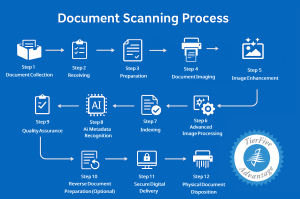
TierFive uses a structured document conversion workflow designed to maintain records accountability, chain of custody, image quality, indexing accuracy, and secure delivery.
View Our 10-Step Document Scanning Process
1. Project Assessment: Review document quantities, condition, scanning specifications, indexing, security, and delivery requirements.
2. Secure Records Collection: Arrange pickup, shipment, or other approved transfer methods using documented handling procedures.
3. Receiving, Inventory & Tracking: Verify incoming containers, record discrepancies, and apply labels or barcodes for accountability.
4. Document Preparation: Remove fasteners, organize pages, and preserve required document and folder order.
5. High-Volume Scanning: Digitize records using professional production scanning equipment.
6. Image Enhancement & OCR: Improve image quality and apply searchable text recognition when specified.
7. Document Indexing: Assign filenames, metadata, and customer-defined folder structures.
8. Quality Assurance: Review image quality, completeness, organization, and indexing against project specifications.
9. Secure Digital Delivery: Deliver completed files in the agreed formats and electronic structure.
10. Original Records Disposition: Return, retain, or securely destroy originals according to customer authorization and retention requirements.
Secure Document Scanning & Chain of Custody
TierFive understands that business-critical records require careful handling throughout the digitization process. Our document conversion workflows incorporate secure collection, inventory and barcode tracking, controlled processing, background-verified personnel, confidentiality procedures, image quality control, and secure electronic delivery.
🛡 Secure Chain of Custody ✓ U.S.-Based Processing ✓ 20+ Years Experience ✓ Security-Focused
Why Alameda County Organizations Choose TierFive
Experience: Since 2005, TierFive has helped organizations convert paper records into accurate, searchable electronic files.
Full-Service Conversion: Services can include records pickup, document preparation, scanning, image enhancement, OCR, indexing, quality assurance, and electronic delivery.
Production Capability: TierFive handles projects ranging from small departmental collections to large backfile archives, microfilm, and oversized drawings.
Quality & Accountability: Defined processing workflows help maintain document order, image quality, indexing consistency, and chain-of-custody records.
Project-Specific Security: Confidentiality, data protection, contractual requirements, and applicable regulatory obligations can be reviewed during project planning.
Convenient Service: Regularly scheduled records pickup is available in participating Alameda County service areas.
Alameda County Document Scanning Pricing & FAQs
How Much Does Document Scanning Cost in Alameda County?
Pricing depends on document volume, preparation requirements, paper condition, scanning resolution, color requirements, OCR, indexing, file organization, transportation, and turnaround time. TierFive provides project-specific quotations based on your records and required deliverables.
Does TierFive Provide Document Scanning in Oakland?
Yes. TierFive provides document scanning, OCR, indexing, microfilm conversion, and related records digitization services for Oakland businesses and organizations.
Is Scheduled Records Pickup Available in Alameda County?
Regularly scheduled records pickup is available in participating Alameda County service areas. Contact TierFive with your ZIP code and project details to confirm current arrangements.
What Alameda County Cities and ZIP Codes Are Served?
TierFive serves organizations throughout Oakland, Fremont, Berkeley, Hayward, Pleasanton, Livermore, Dublin, San Leandro, Alameda, Union City, Newark, Emeryville, and surrounding communities. See the city and ZIP-code directory above.
Can TierFive Scan Hundreds or Thousands of Boxes?
Yes. TierFive specializes in high-volume backfile conversion and can develop workflows for projects involving hundreds or thousands of boxes.
Does TierFive Scan Medical Records?
Yes. TierFive provides secure healthcare records conversion with project-specific confidentiality, handling, and HIPAA-related requirements addressed during planning.
Can TierFive Convert Microfilm and Microfiche?
Yes. TierFive digitizes roll microfilm, microfiche, aperture cards, and other supported microform collections.
Can TierFive Scan Blueprints and Engineering Drawings?
Yes. TierFive provides large-format scanning for architectural plans, engineering drawings, blueprints, maps, and oversized technical documents.
Is Outsourcing Scanning More Cost-Effective Than Scanning In-House?
Outsourcing can reduce equipment, software, training, staffing, and project-management requirements. The most economical approach depends on document volume, existing resources, quality requirements, and the total cost of each option.
How Long Does It Take to Recover the Cost of Document Scanning?
Payback depends on conversion costs and measurable reductions in filing labor, document retrieval, office space, and offsite storage expenses. Use TierFive’s ROI Calculator to estimate potential savings.
How Does Digitization Help with Disaster Recovery?
Digital records can be securely backed up and stored in multiple locations, reducing reliance on vulnerable paper archives. Recovery depends on appropriate storage, backup, access-control, and restoration procedures.
How Does TierFive Protect Confidential Records?
TierFive uses documented records-handling procedures, chain-of-custody tracking, controlled processing, background-verified personnel, and project-specific security measures.
Can TierFive Preserve Existing Folder Structures?
Yes. Files can be organized using existing folder names, account numbers, employee names, case identifiers, dates, document types, and other customer-defined indexing information.
What Happens to the Original Records After Scanning?
Original documents can be returned, retained, or securely destroyed according to customer authorization and applicable records-retention requirements.
Ready to Digitize Your Alameda County Records?
Whether you have a few boxes, thousands of archived files, microfilm collections, or large-format engineering documents, TierFive can develop a secure conversion workflow around your records. Alameda County is part of TierFive’s California Enhanced Service Area, with regularly scheduled records pickup available in participating areas.
We turn rooms of paper files into searchable .pdfs
Government
TierFive’s comprehensive Access Control helps ensure that only authorized personnel can access sensitive government documents. By utilizing role-based access and multi-factor authentication, we strengthen security, help prevent unauthorized access, and support agency-specific security and compliance requirements.
Healthcare
TierFive uses advanced encryption to help protect electronic protected health information (ePHI) throughout the document scanning process—from digitization and storage to transmission. Our encryption safeguards sensitive patient data and supports healthcare organizations’ HIPAA compliance efforts.
Education
TierFive’s Facility Security includes electronic access control, 24/7 surveillance, key code restricted access, and secure egress systems designed to protect both paper-based and digital education records. Our security measures help prevent unauthorized access and safeguard sensitive FERPA information.
Insurance
At TierFive, we enforce strict Access Control policies to help ensure that only authorized personnel can access sensitive insurance records. These policies support accountability and help protect policyholder information, claims documentation, and financial records from unauthorized access throughout the document scanning process.
Our reputation speaks for itself ask around.
Document Scanning
Convert paper records into secure, searchable digital files with professional scanning, OCR, indexing, image enhancement, quality control, and encrypted delivery. TierFive manages projects from pickup and preparation through final digital output for businesses, government agencies, schools, healthcare organizations, and other records-intensive operations.
Large Format Scanning
Digitize blueprints, engineering drawings, architectural plans, maps, plats, surveys, and other oversized records using high-resolution large format scanning. TierFive preserves fine detail, annotations, scale, and readability while producing digital files that are easier to store, retrieve, share, and integrate into engineering or records-management workflows.
Indexing Services
Make scanned records easier to find with document indexing and structured metadata. TierFive captures names, dates, account numbers, document types, reference codes, and other required fields using OCR-assisted extraction, key-from-image entry, validation rules, and human review, with index data prepared for delivery or system import.

Back File Scanning
Convert years of stored paper records into organized, searchable digital archives with high-volume backfile scanning. TierFive can process boxed records, filing cabinets, departmental archives, and large records-retention backlogs while maintaining document order, chain of custody, indexing requirements, and quality control throughout the conversion project.

Microfilm Scanning
Convert legacy microfilm and microfiche into searchable digital records using specialized film-scanning equipment and image-processing workflows. TierFive digitizes 16mm and 35mm roll film, microfiche, aperture cards, and other archival media while enhancing image quality and organizing output for long-term preservation, retrieval, and digital records access.